
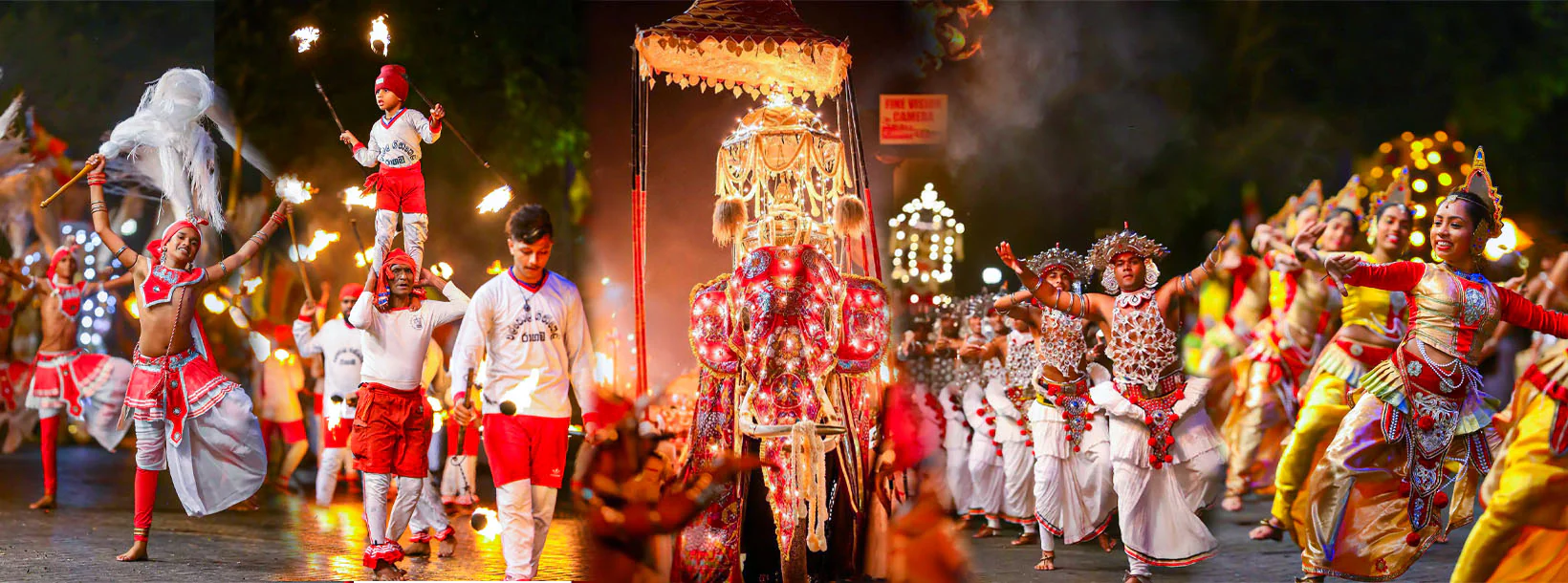
For over two millennia, the island nation of Sri Lanka has preserved a cultural legacy that seamlessly blends deep religious devotion with regal historical grandeur. At the absolute pinnacle of this cultural preservation is the Kandy Esala Perahera (the Festival of the Sacred Tooth Relic). Held annually in the hill capital of Kandy, this ten-day festival is not merely a tourist attraction; it is a living, breathing manifestation of Sri Lankan identity, a sacred ritual, and arguably the most spectacular Buddhist pageant in all of Asia.
The festival takes place during the lunar month of Esala (usually falling in late July or August). For ten consecutive nights, the normally serene streets of Kandy a UNESCO World Heritage city are transformed into an explosion of light, rhythmic drumming, breathtaking choreography, and deep spiritual reverence.
Historical Origins and Sacred Significance
To truly appreciate the grandeur of the Esala Perahera, one must understand its dual historical roots: the Sinha Perahera (a ritual for rain) and the Dalada Perahera (the procession of the Tooth Relic).
Originally, the festival dates back to the 3rd Century BCE, originating as a ritualistic prayer to the gods for rain, fertile lands, and bountiful harvests. However, the festival took on its modern, deeply sacred meaning in the 4th Century CE, when the Sacred Tooth Relic of Lord Buddha was brought to Sri Lanka from Kalinga, India, hidden in the hair of Princess Hemamala and her husband, Prince Dantha.
The Relic quickly became the ultimate symbol of sovereignty. It was believed that whoever possessed the Tooth Relic held the divine right to rule the island. When the capital shifted through various kingdoms over the centuriesfrom Anuradhapura to Polonnaruwa, and finally to Kandy the Relic moved with it.
The modern format of the Perahera was established during the reign of King Kirthi Sri Rajasinghe (1747–1782). Prior to his decree, the Relic was kept private. The King ordered that the Relic be taken in a public procession so that ordinary citizens and pilgrims could gaze upon the golden casket, receive blessings, and celebrate their faith.
The Sacred Preliminary: Kap Situvingima
The grand public spectacles do not begin overnight. The festival formally commences with a private, highly traditional ritual known as Kap Situvingima.
In this ritual, a young, fruit-bearing Jackfruit tree (Artocarpus integrifolia) is blessed, cut down, and divided into four logs. Each log is brought to the premises of the four primary Devales (shrines) dedicated to the guardian deities of the island:
- Natha(The deity associated with the future Buddha)
- Vishnu(The protector of Buddhism on the island)
- Kataragama(The warrior god of victory)
- Pattini(The goddess of health and purity)
For the next five nights, internal processions are held within the grounds of these four shrines. This acts as a spiritual preparation before the grand pageantry spills onto the public streets.